Military jets — naming what just went over
Three questions get you most of the way: how many engines, how many fins, and is it a delta with canards or a conventional wing with a tailplane behind it?

One engine, one fin
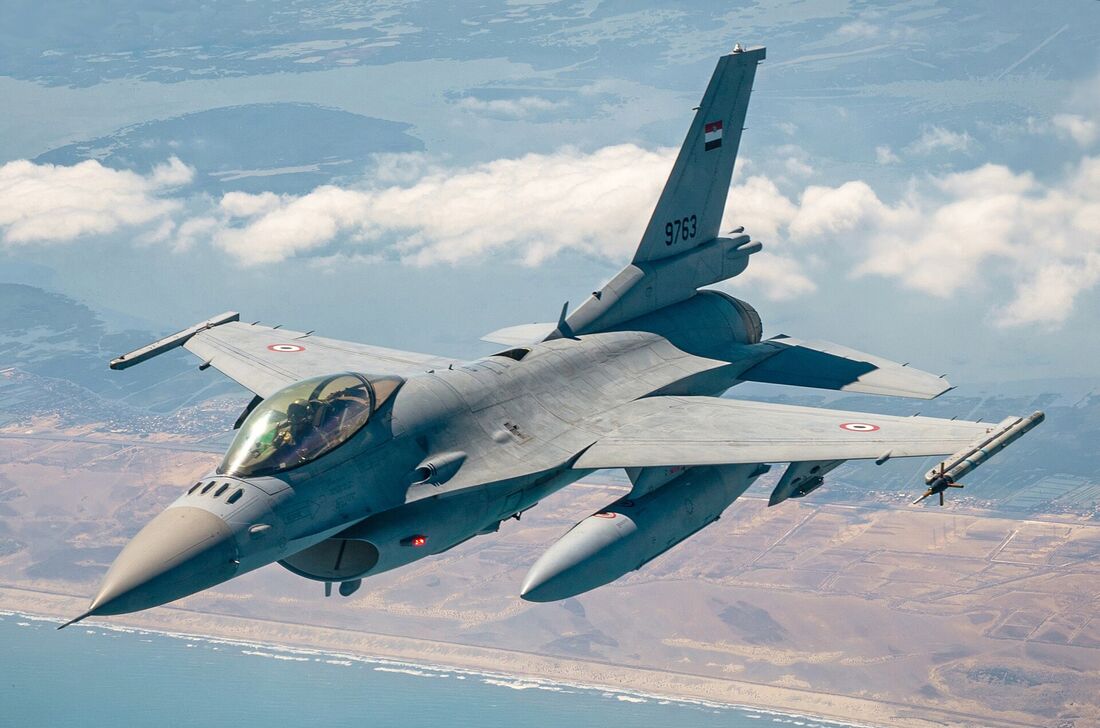
- F-16 Fighting Falcon — a single oval intake under the nose, one fin, and a frameless bubble canopy sitting high and well forward. Designed by General Dynamics, built by Lockheed Martin since, and the most widely produced Western fighter of its generation, which is why it turns up at almost every airshow.
- Saab Gripen — delta wing with canards immediately behind the cockpit, side intakes, one engine, one fin. Small and visibly light.
- Mirage 2000 — a pure delta: no canards, no separate tailplane at all. Single fin, single engine, semi-circular side intakes with a shock cone in each. Its Mirage III and 5 ancestors share the outline and look older.
The exception worth knowing
The F-35 Lightning II has one engine but two canted fins, which breaks the usual rule. Its real tells are the shoulder intakes with a smooth bump instead of a splitter plate, and a fuselage that looks faceted and slightly bloated compared with an F-22.
Two engines, two fins
- F-15 Eagle — big rectangular box intakes right alongside the cockpit and a very large wing. It looks heavier than everything else in the pattern, because it is.
- F/A-18 Hornet and Super Hornet — canted twin fins and prominent leading-edge root extensions. The legacy Hornet's intakes are rounded; the Super Hornet's are rectangular and the whole aircraft is noticeably larger.
- F-22 Raptor — a diamond-planform wing, strongly canted fins, faceted stealth shaping and thrust-vectoring nozzles. Rarely seen outside the United States.
- MiG-29 and the Su-27 family (Su-30, Su-34, Su-35) — widely spaced engines with a tunnel of clear air between them, huge blended wing-root extensions, twin fins. The Su-34 has a flattened side-by-side cockpit and the Su-30/35 variants add canards.
The European canard deltas
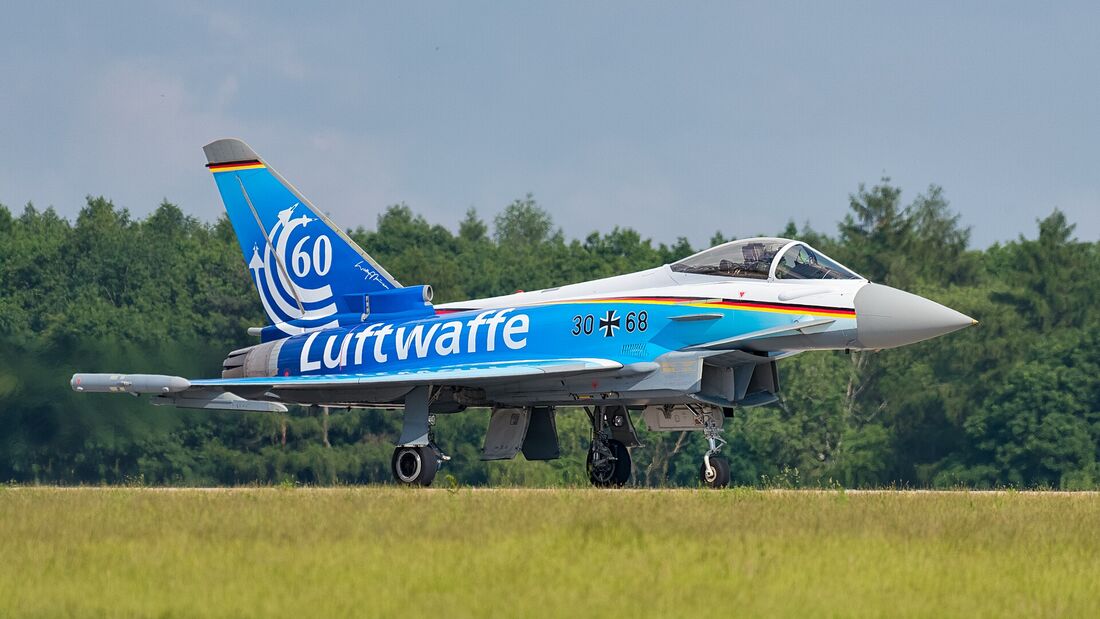
Eurofighter Typhoon and Dassault Rafale both pair a delta wing with canards and are the pair most often confused. Canard position separates them: the Typhoon's sit high and well forward, near the nose, with a single chin intake below the cockpit; the Rafale's are lower and much closer to the wing, with curved intakes on the fuselage sides. The Typhoon also looks longer and more angular, the Rafale stubbier.

Not fighters
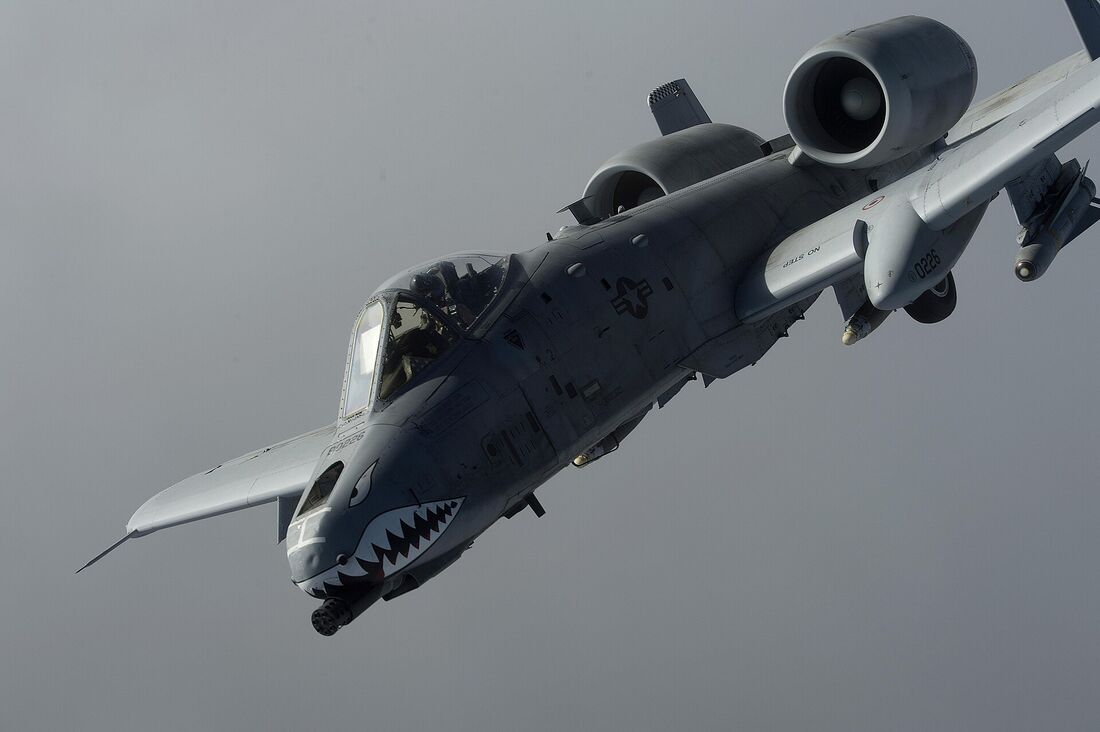
- A-10 Thunderbolt II — twin fins, engines podded high on the rear fuselage, straight wing, gun in the nose. Nothing else looks remotely like it.
.jpg)
- C-130 Hercules — four turboprops, high wing, ramp at the back. Six-blade scimitar propellers mean a C-130J.
- Airbus A400M — four turboprops with eight-blade scimitar props that counter-rotate in pairs, which is unique and audible.
- C-17 Globemaster III — high wing, four jets, T-tail, winglets.
- Tankers — the KC-135 is narrow with four podded engines and a boom under the tail; the KC-46 is a 767 and the A330 MRTT an A330, both with underwing pods.
- Trainers — BAE Hawk, Beechcraft T-6 Texan II, Pilatus PC-21 and Leonardo M-346 are what most air forces actually fly day to day.
Display teams, by aircraft
Useful in reverse, when you know the paint and not the type: the Red Arrows fly the BAE Hawk, the Thunderbirds the F-16, the Blue Angels the F/A-18 Super Hornet, the Frecce Tricolori the Aermacchi MB-339, and the Patrouille de France the Alpha Jet.
Where you'll see them, and the one rule that really matters
Public display days and airshows are the dependable answer, and they are also where you get close enough for the details above to be visible. Perimeter spotting at military airfields is a different proposition from civil spotting: photographing military aircraft and installations is restricted or outright illegal in a significant number of countries, and "I was standing on a public road" is not the defence there that it is at a civil airport. Check local law before you travel, not afterwards — the same principle as the spotting page, applied somewhere it has real consequences.
One practical note on tracking: most military aircraft either do not transmit ADS-B in the clear or are filtered out of the public feeds, so an empty map means nothing. See watch live.
Photographs and references
For photographs of the real thing, Wikimedia Commons' military aircraft category is freely licensed and very large, and planespotters.net pairs its photos with each individual airframe's build date, operator history and fate. Military photography is the one corner where the licensing is easy: imagery released by the US armed forces is generally public domain as a work of the federal government, so Commons carries a very deep archive of American types in particular. European air forces mostly publish under their own terms, so check the notice on the page you take an image from.